Integration with Binotel can be set up in just a few steps and will allow you to:
-
make calls from the CRM and handle incoming calls;
-
see who is calling you if the customer is already in the system;
-
create customers, orders, or requests directly from the call card;
-
view the entire call history, including call recordings.
Step 1. Obtain the login credentials for Binotel
Before connecting, you must obtain API keys from Binotel support. To do this, send an email to support@binotel.ua:
Email Subject: Requesting Authorization Credentials for the REST API
Email Body:
Good afternoon!
Please provide the API keys for integration with the CRM.
Thank you.
Step 2. Connecting to keyCRM
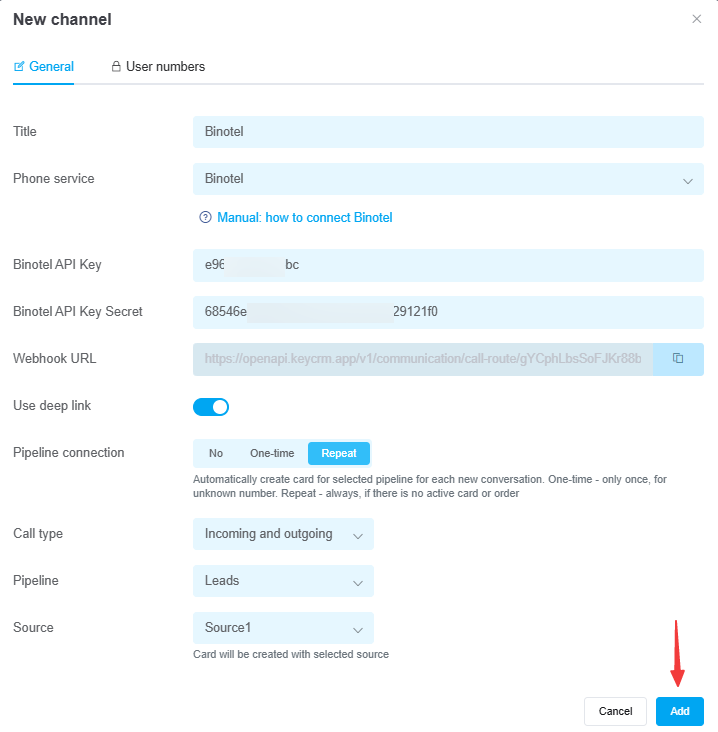
After receiving the keys, go to «Settings» → «Communications» → the «Calls» tab and click the «Add new integration» button.
In the window that appears, on the «General» tab:
-
Title — Enter the name of the telephony service;
-
Phone service — Select «Binotel».
-
Binotel API Key and Binotel API Key Secret — Enter the API keys provided by Binotel;
-
Webhook URL — Copy the link for further configuration on the telephony side;
-
Use deep link — enable this if you are using a softphone that supports this technology;
-
Connection to pipelines — enable this and select a value:
• No — cards will NOT be created automatically from calls;
• One-time — cards will be created only once, provided there is no existing card for this number;
• Repeat — cards will always be created for repeat calls, provided there is no card for the number in active statuses (all statuses except successful and rejected). -
Call Type — select the call type from which cards will be created: incoming only, outgoing only, or all — incoming and outgoing;
-
Pipeline — specify the pipeline for creating cards. If you have only one pipeline, it is selected automatically, and the selection field will not appear;
-
Source — select the source from which the card will be created. If you do not select one, the card will be created with an empty value in the source field.
How the deep link feature works
Deep link — a feature that immediately initiates a call in the device's default app.
How it works:
-
If your device has a default softphone app set for calls, and the deep link feature is enabled in the phone settings: when you click «Call» in the CRM, this app opens immediately to place a call to the client.
-
You should enable deep linking only if you use a softphone that supports this technology (for example, MicroSIP or the paid version of Zoiper). If you’re unsure, you can test it. Enable it first; if outbound calls from the CRM don’t work, then disable it.
-
If you disable deep linking, the call will be made through the telephony system itself. First, the CRM sends a request to the telephony system to initiate the call; upon receiving it, the telephony system places the call to the manager’s softphone or IP phone, the manager picks up the phone, and the connection with the client begins.
-
IP phones do not support the deep link feature, so when working with them, it must be disabled.
Step 3. Connecting the numbers
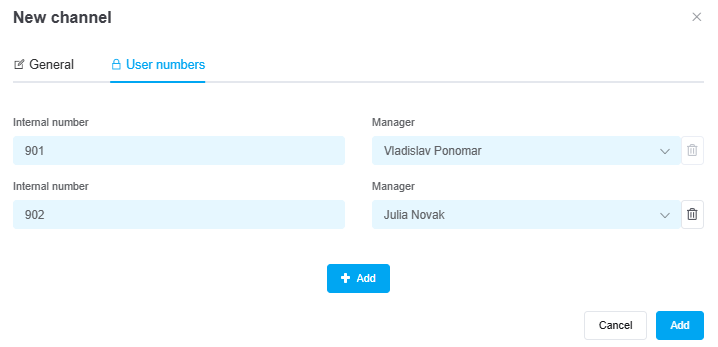
In the settings window, go to the «User numbers» tab and fill in the following information:
-
Internal number — the Binotel internal phone line number;
-
Manager — the CRM user associated with this number.
The dropdown list will include users who have been granted access to telephony.
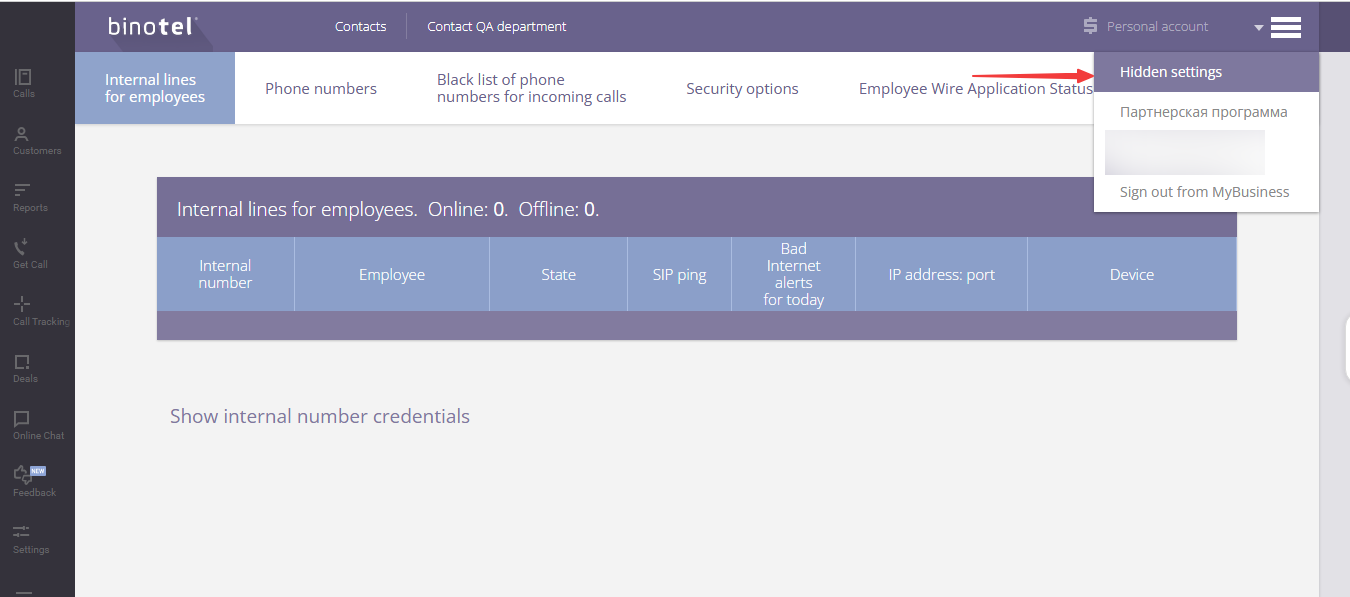
To set up internal numbers, go to the Binotel admin panel → Hidden settings → the «Internal lines for employees» tab:
After entering the information, be sure to save the channel and proceed to the next step.
Step 4. Request to set up a webhook in Binotel
Open the connected telephony settings window and copy the Webhook link:
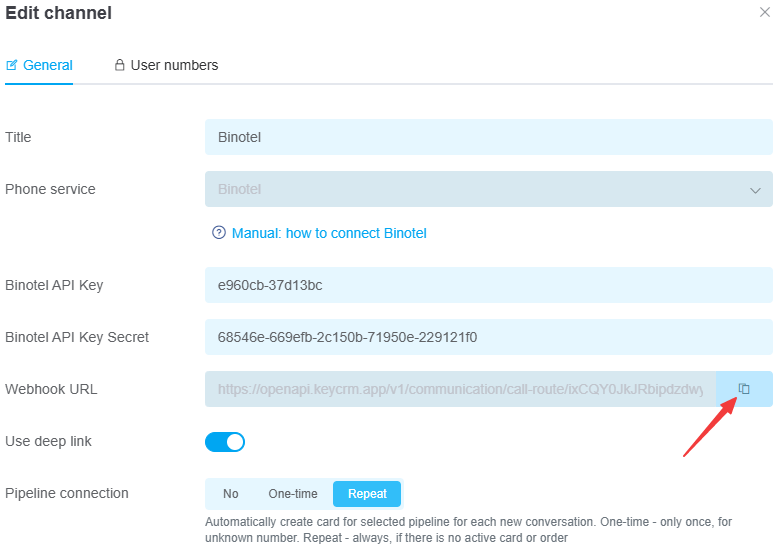
To complete the integration, send an email to support@binotel.ua requesting that the webhook be enabled:
Email Subject: Setting up a webhook for CRM integration
Email Body:
Good afternoon!
Please change the webhook for the API-PUSH, api-call-completed, and api-call-settings methods to:INSERT THE LINK TO THE WEBHOOK COPIED FROM THE SETTINGS HERE
Thank you!
Once you receive confirmation that the setup is complete, the integration will be activated, and calls will start coming into the system and being saved in the call history.
Now you can manage phone calls, and in the Binotel dashboard, when you click on a subscriber, you can immediately open the customer profile in KeyCRM.
Saving UTM tags from calls
To pass UTM tags, you need to enable and configure the Call Tracking feature in Binotel. If an incoming call arrives in the CRM with UTM tags, they are stored in:
-
a pipeline card, created automatically or linked to a call that did not have tags;
-
a pipeline card created from a call card;
-
an order created from a call card.
If multiple cards or orders were created from the call card, the tags will be saved in all of them.
Consequently, they will not be changed in a previously created card or order with tags when a follow-up call is made that has different tags.
You can view reports by tag in the pipeline analytics in summary tables and in the order analytics in summary tables.
